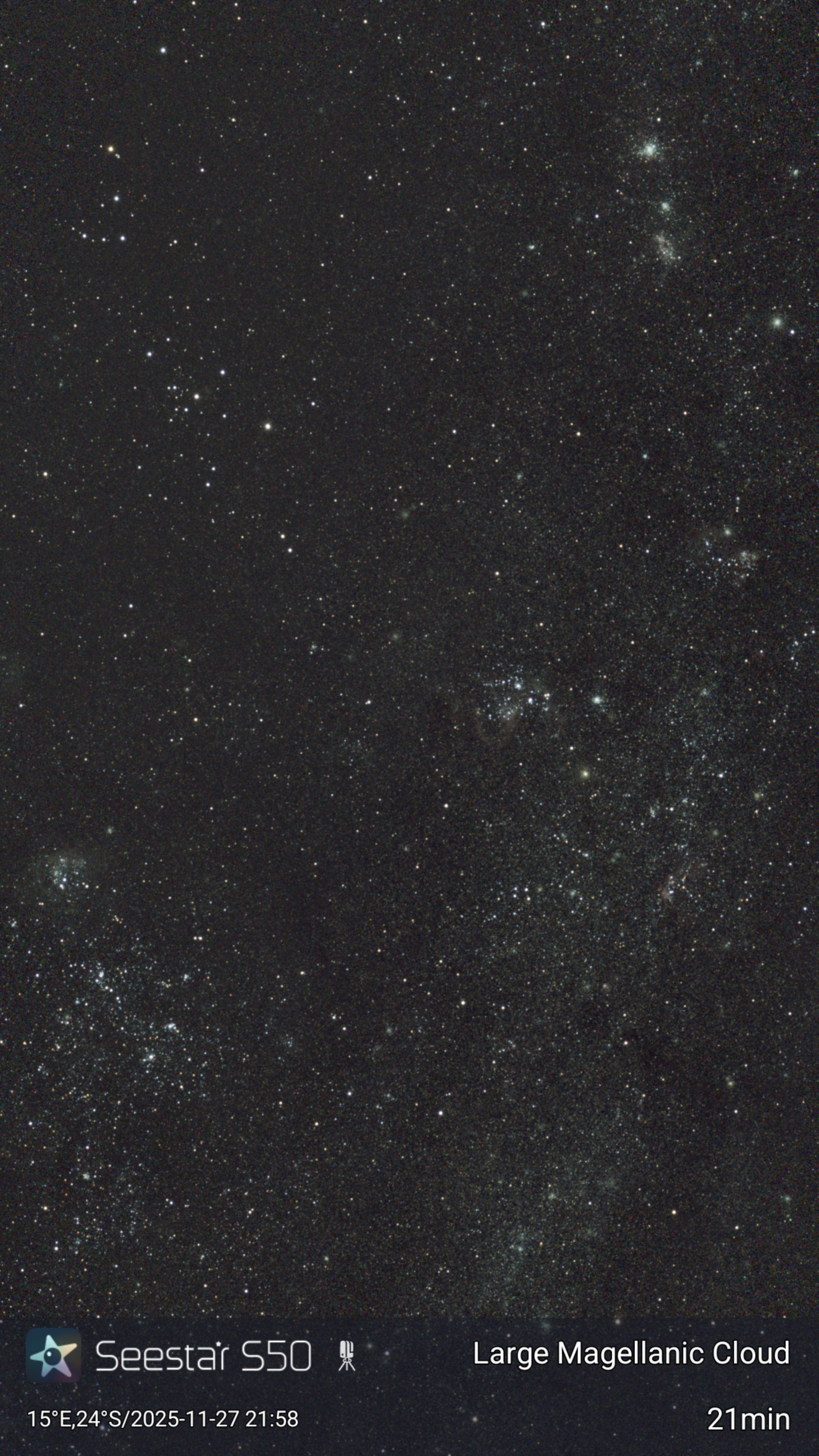
While I was out in Namibia doing the guest astronomer position during November at a desert lodge about 330 km’s from Windhoek (the capital), every clear evening (most of the month!) I would see two small clouds in the southern sky. These are not actual clouds but satellite galaxies of our own Milky Way galaxy, the Large Magellanic Cloud (LMC), about 163,000 light years (LY) away and the Small Magellanic Cloud (SMC), about 200,000 LY away. Every night I would point out these ‘clouds’ to the guests but never really looked at them, so as I was now into my last week of five in Namibia, I decided I would give them a better look. Using my Sky & Telescope pocket guide sky atlas as the reference, I would have a look at these clouds.
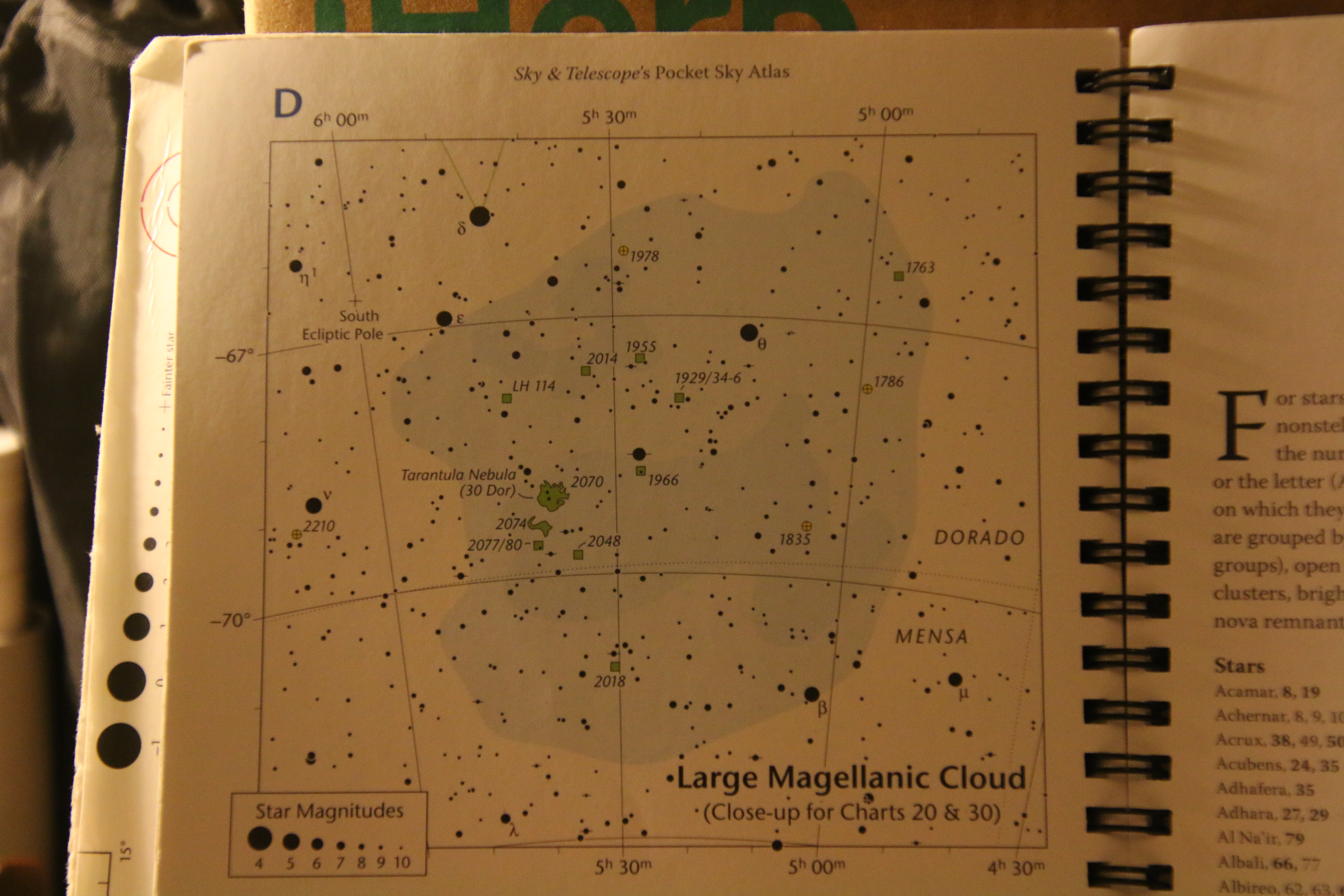
On the evening of the 27th of November using the lodge’s 11 inch Celestron CPC telescope with a Baader Hyperion zoom eye piece set at 16 mm, starting at 20:40 with a temperature of 28 °C and no wind (this was warm conditions, normally it would be around 23 ish?) and a half moon lighting up the sky a bit, I could see my shadow very clearly! First target was the LMC and New General Catalogue (NGC) 1786, this is a globular cluster (GC), a small fuzzy blob (FB) with a bright core and a magnitude (Mag) of 10.1, magnitude is the brightness of the object with a higher number meaning it is a dimmer object to view.
Next object was another GC in NGC 1835, this is very similar to NGC 1786 but a bit brighter with a Mag of 9.8, NGC 1978 was another GC but could not make out the core, and this had a Mag of 9.9. Onto the first open cluster (OC) and NGC 2070, better known as the Tarantula nebula or Caldwell (C) 103, this is a small OC at the centre of the nebula, coming in with a Mag of 8.2, it is very bright to look at.
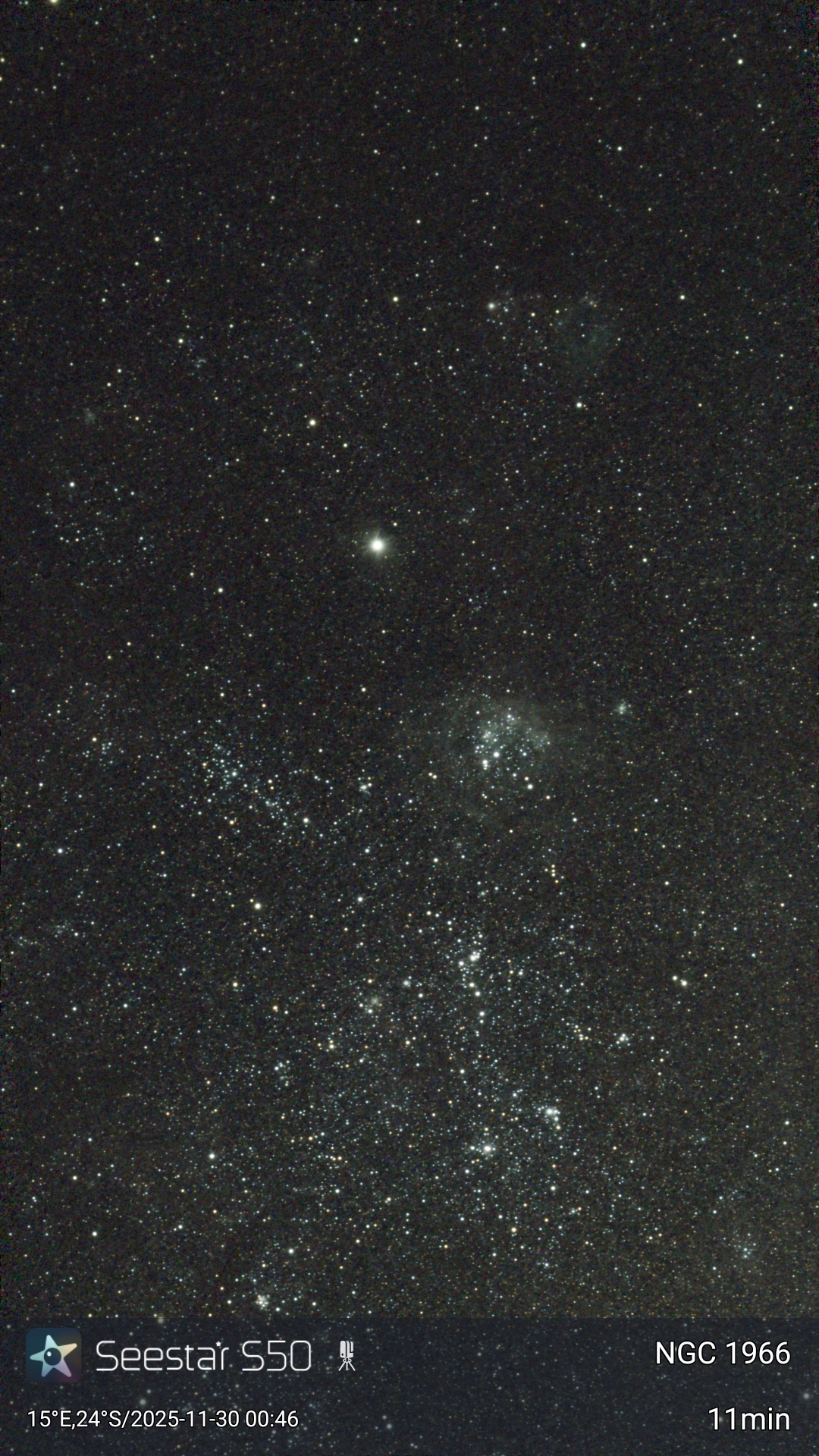
Onto another OC and NGC 2074, a small dim cluster with not many stars within the group. NGC 2018 is an Emission nebula (EN) and OC, this is a very small cluster, could only make out a couple of stars? NGC 2077 is a very small cluster of stars but I could not make out any stars, must have been very dim to look at? NGC 2048 is an EN but unfortunately I could not make it out, probably the phase of the moon does not help! The same comments for NGC 1966, this is an OC. Another OC and EN is NGC 2014, this is a small sparse cluster with not many stars within the group, has a Mag of 8.0, and at a mag of 9.0 is NGC 1955, another small OC. NGC 1763 is an EN with three close OC’s nearby, this EN was a faint fuzzy blob (FFB) to look at, it is also known as the Bean nebula? The Ghost Head nebula (NGC 2080) is an EN with a hint of a core, was a FFB to look at. Final object within the LMC (according the sky atlas) is NGC 1929 an OC associated with an EN.
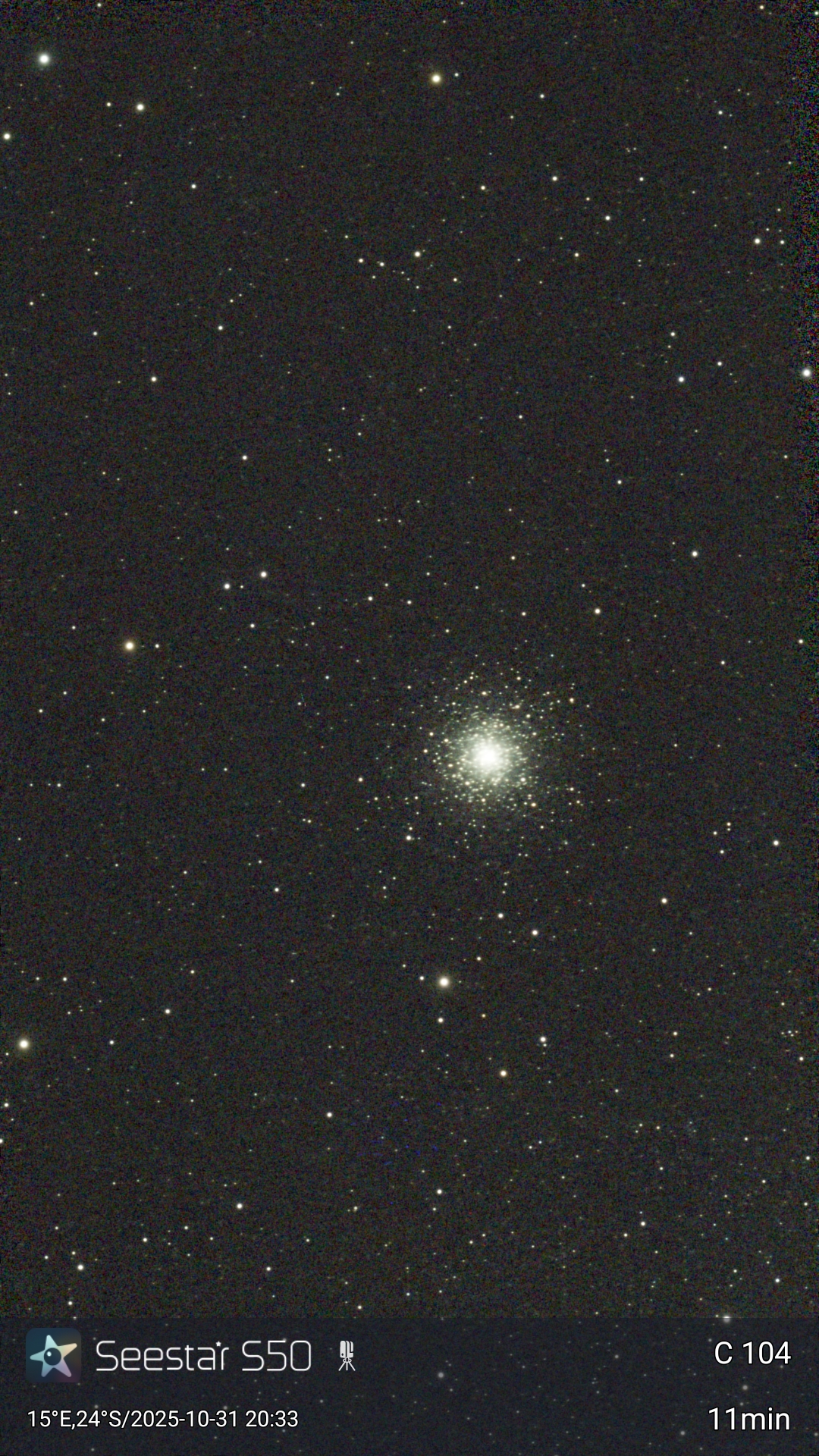
Now onto the SMC, starting with NGC 419, this is a GC with a Mag of 10.0, no detail to look at, a FFB. NGC 362 also known as C 104 is a bright GC with some stars seen on the edge of this cluster, comes in with a Mag of 6.2.
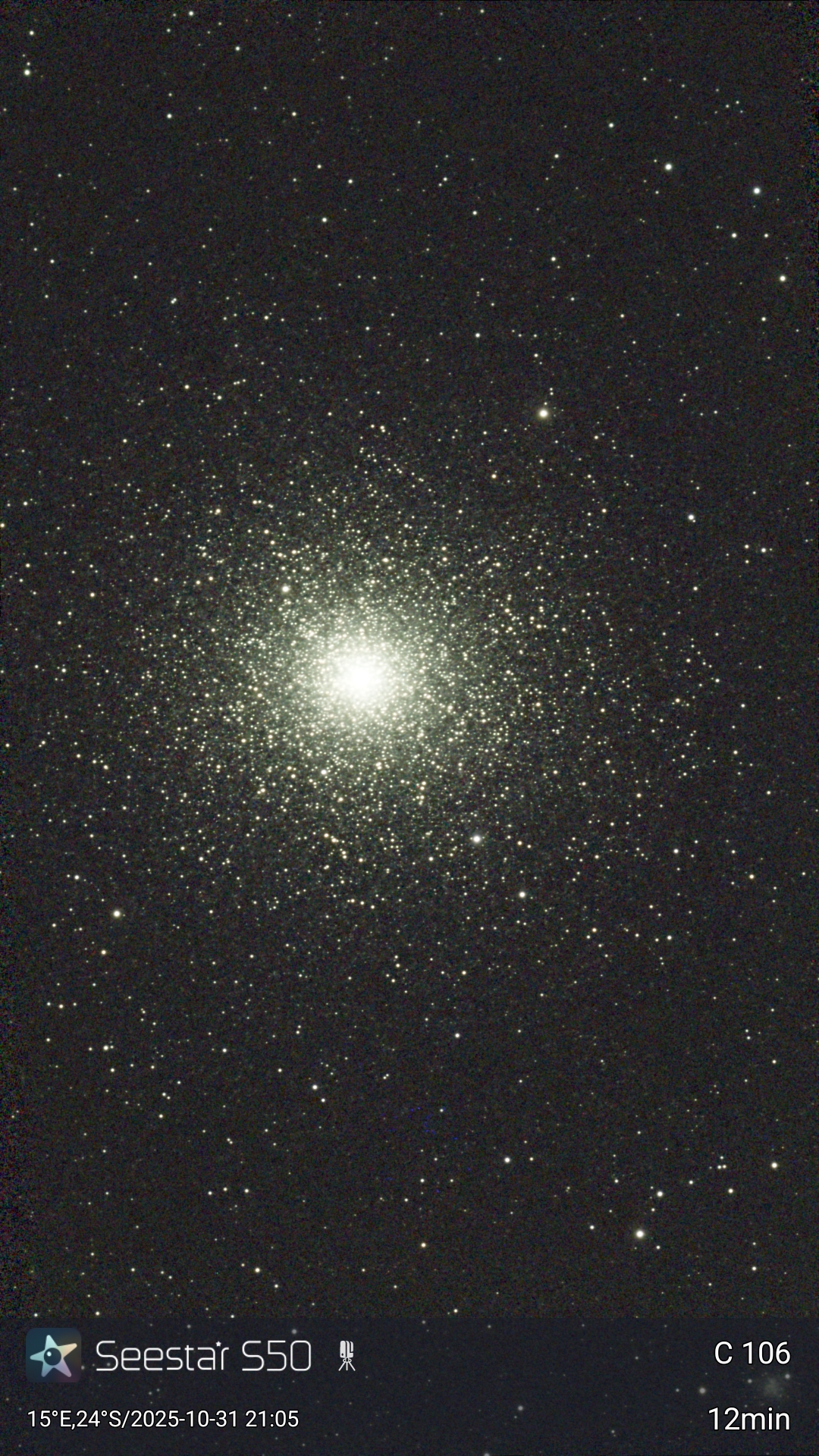
47 Tucana or C 106 is the second brightest GC in the whole sky, only beaten by Omega Centauri and is a delight to view with the eye, there is a lot of stars to be seen while viewing this object. NGC 460 is a small and very faint OC, very hard to make out. Index Catalogue 1660 is an OC but I could not see it, comes in with a Mag of 13.0, probably beyond the limits of this telescope or the moon made it invisible?
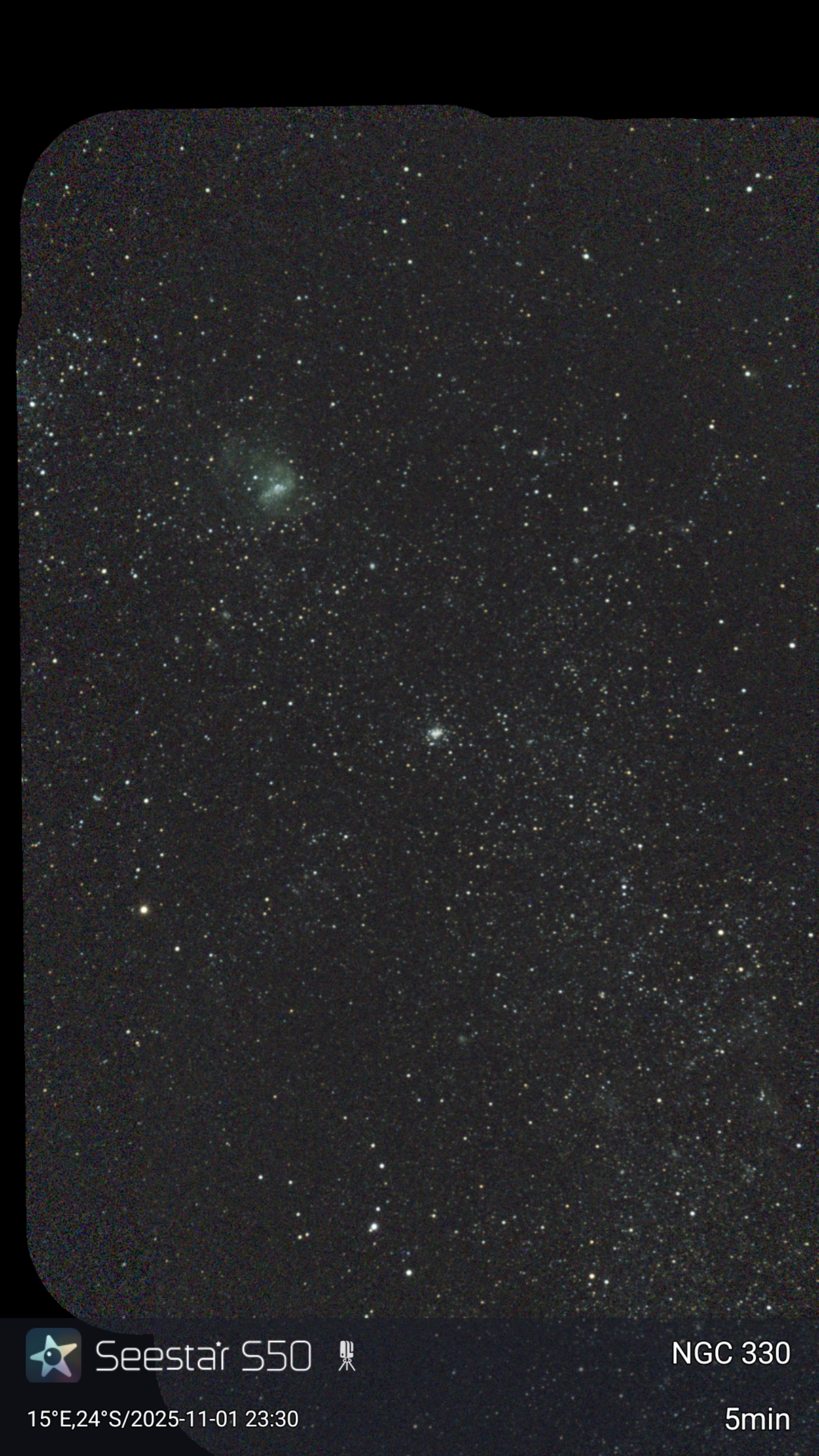
NGC 330 is a small OC, just a fuzzy patch but could not make out any stars. Final object was NGC 346, an EN was a grey blob to look at.
The time was 23:46 when I finished looked at these clouds, I did have some guests during the evening, so I showed them the highlights of the sky including the LMC & SMC but nothing within the clouds apart from NGC 2070 and 47 Tucana.
Temperature had dropped to around 23 °C and still no wind.
Clear skies.
Peter Chappell
HTML Website Maker